Why Traditional Firewalls Are No Longer Enough
For decades, most businesses operated on a simple security assumption: trust everything inside the network, block everything outside. Firewalls and VPNs were enough when employees worked in the office and data stayed on local servers.
That model no longer holds. Today, employees work from home, access company systems from personal devices, and store data across multiple cloud platforms. Attackers no longer need to break through your firewall — they simply log in using stolen credentials, which is exactly what Cloudflare’s 2026 Threat Report identified as one of the fastest-growing attack vectors globally.
In Australia, the impact is real. The Australian Cyber Security Centre (ACSC) responded to over 1,200 cybersecurity incidents in the 2024–25 financial year — an 11% increase year-on-year. For IT managers and business owners, the question is no longer if a perimeter-based approach will fail, but when.
What Zero Trust Actually Means
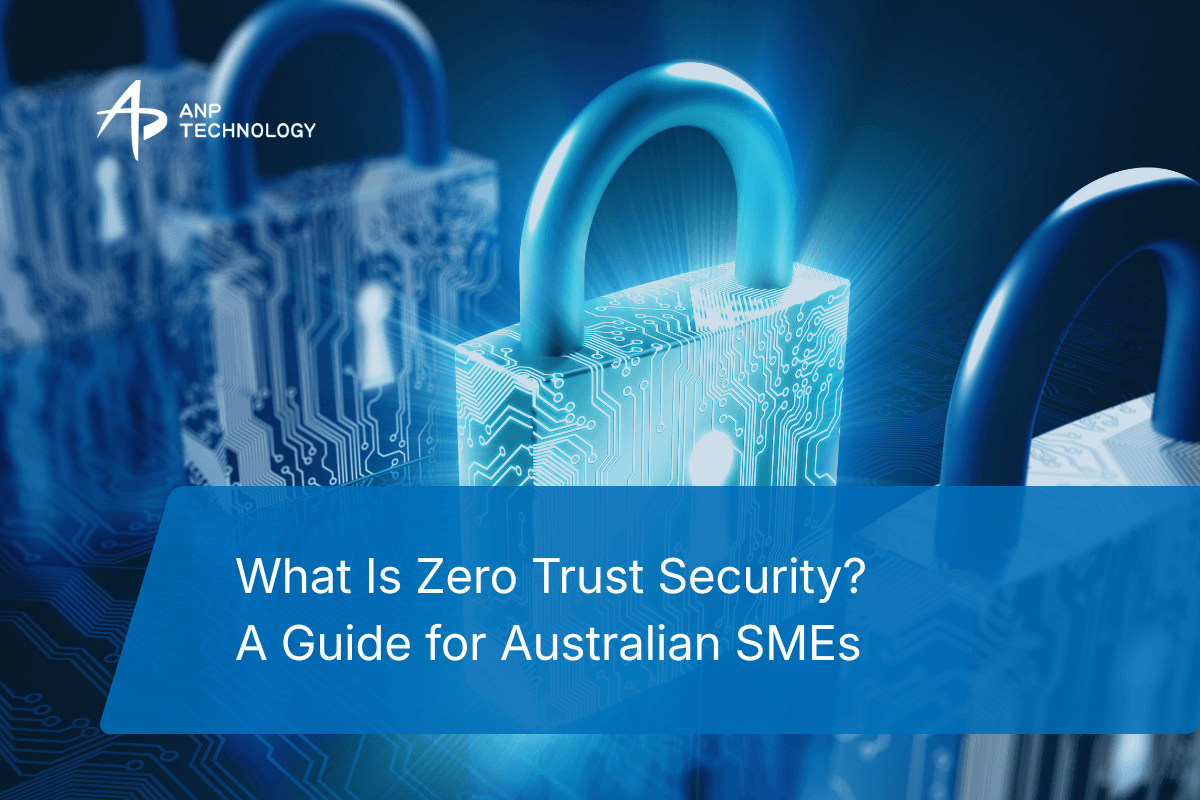
Zero Trust is a security framework built on one principle: never trust, always verify. Instead of assuming that anyone inside the network is safe, Zero Trust requires every user, device, and connection to prove its legitimacy — every single time.
In practice, this means:
- Users must authenticate before accessing any resource, even internal tools
- Devices are checked for compliance before they connect
- Access is limited to exactly what each user needs — nothing more
- All activity is logged and monitored in real time
Zero Trust is not a single product — it is an architecture. But solutions like Cloudflare Zero Trust make it practical to implement, even for businesses without a large IT team.
The Biggest Risks Zero Trust Solves for Australian Businesses
Zero Trust directly addresses three of the most common and costly attack types affecting Australian organisations in 2026:
- Credential theft and account takeover: Even if an attacker obtains a valid username and password, Zero Trust prevents them from moving laterally across systems.
- Remote work vulnerabilities: Employees accessing company data from home networks or personal devices no longer create blind spots — every session is verified.
- Supply chain and third-party access: Contractors and vendors are granted minimal, time-limited access, reducing the risk of a third-party breach cascading into your core systems.
For Australian businesses in regulated industries — finance, healthcare, critical infrastructure — adopting Zero Trust is also increasingly aligned with compliance obligations under the SOCI Act and APRA’s CPS 234 guidelines.
How to Get Started with Cloudflare Zero Trust
Implementing Zero Trust does not have to be a large-scale, disruptive project. Cloudflare Zero Trust offers a cloud-native platform that can be deployed incrementally, starting with the areas of highest risk.
A practical starting point for most Australian SMEs includes:
- Replace VPN with Cloudflare Access for secure, identity-based remote access
- Enable DNS filtering to block malicious domains before they reach endpoints
- Apply device posture checks to ensure only compliant devices connect to business systems
- Use Cloudflare Gateway to inspect and control all web traffic
ANP Technology is an authorised Cloudflare partner in Australia. We help businesses assess their current security posture and implement Zero Trust at a pace and scale that suits their team and budget.
Not sure where your business stands on cybersecurity? ANP Technology offers free consultations to help Australian businesses identify gaps and find the right solution, welcome to contact us now.