If your business website suddenly goes offline for no apparent reason — no scheduled maintenance, no server failure — there’s a real chance you’ve just become the target of a Distributed Denial of Service (DDoS) attack.
For Australian businesses, this isn’t a hypothetical. According to the Australian Signals Directorate (ASD) Annual Cyber Threat Report 2024–25, DDoS attacks against Australian organisations surged by more than 280% in a single year, with June 2025 potentially recording the highest number of DDoS incidents ever in Australia. Even more concerning: these attacks are no longer reserved for large enterprises. Small and medium-sized businesses are increasingly in the crosshairs.
So what exactly is a DDoS attack, how does it work, and — most importantly — what can your business do about it? This guide has the answers.
What Is a DDoS Attack?
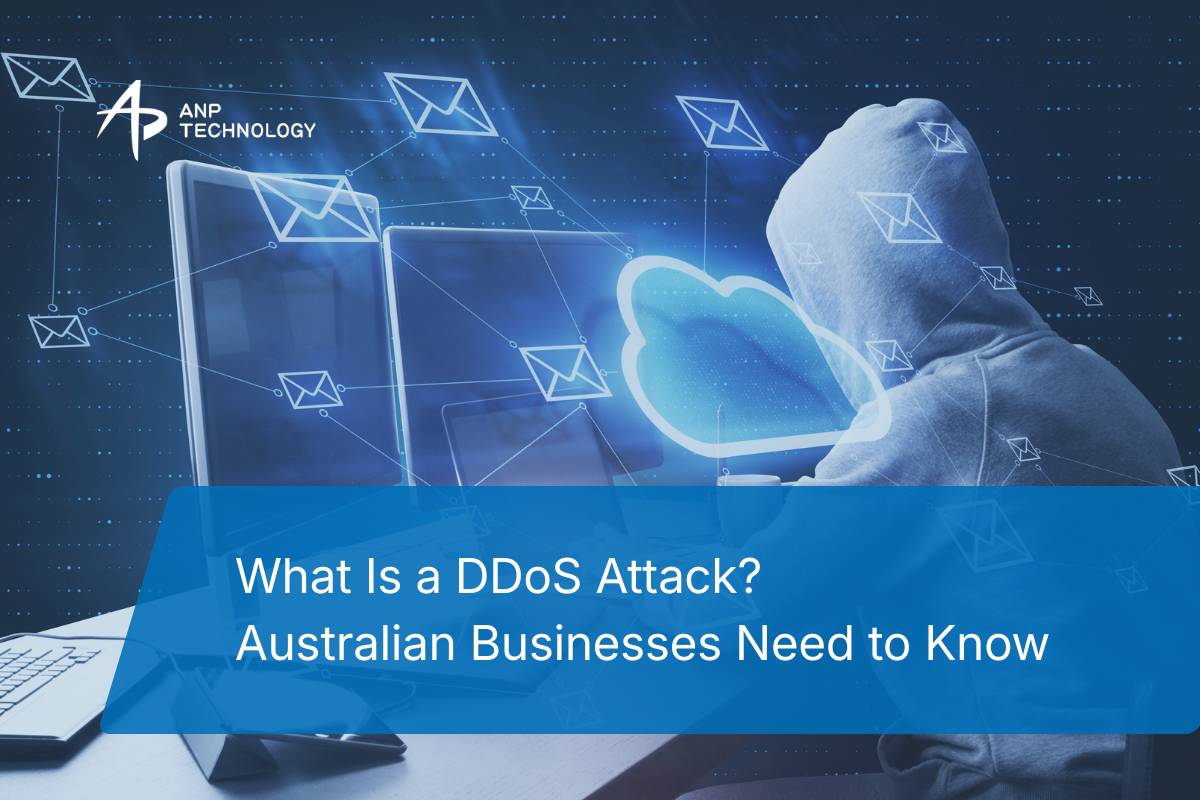
A Distributed Denial of Service (DDoS) attack is a type of cyberattack designed to overwhelm a target — typically a website, server, or online service — with a flood of malicious internet traffic, rendering it slow or completely inaccessible to legitimate users.
The “Distributed” in DDoS is key. Unlike a simple Denial of Service (DoS) attack launched from a single machine, a DDoS attack uses hundreds, thousands, or even hundreds of thousands of compromised devices — collectively known as a botnet — to flood the target simultaneously. These devices can include anything from PCs and servers to IoT gadgets like routers and cameras that have been quietly hijacked by attackers without their owners’ knowledge.
The goal is straightforward: knock your website or service offline, disrupt your operations, and in many cases, extort a ransom payment in exchange for stopping the attack.
How Does a DDoS Attack Work?
Understanding the mechanics of a DDoS attack helps clarify why they’re so difficult to defend against without the right tools.
Step 1 — Building the botnet. Attackers infect internet-connected devices with malware, often through phishing emails or unpatched software vulnerabilities. These infected devices become “bots,” waiting silently for instructions.
Step 2 — Launching the flood. When the attacker activates the botnet, every compromised device simultaneously sends traffic to the target. This can amount to hundreds of gigabits or even terabits of data per second — far more than most business networks can handle.
Step 3 — Service collapse. Overwhelmed by the volume of requests, servers slow to a crawl or go completely offline. Legitimate customers, staff, and partners are locked out.
Step 4 — Extortion or disruption. Some attackers demand a ransom to stop. Others use the DDoS attack as a smokescreen to cover a simultaneous data breach attempt.
Types of DDoS Attacks
Not all DDoS attacks are created equal. Knowing the three main types helps you understand what defence measures are needed.
Layer 3/4 — Volumetric Attacks
These are the blunt-force attacks: massive floods of network traffic (UDP floods, ICMP floods) designed to saturate your bandwidth. They’re measured in gigabits per second (Gbps) and can overwhelm even well-provisioned infrastructure.
Layer 4 — Protocol Attacks
These exploit weaknesses in network protocols — most commonly TCP — to exhaust server resources. A SYN flood attack, for example, sends thousands of connection requests but never completes the handshake, leaving servers waiting and eventually running out of capacity.
Layer 7 — Application Layer Attacks
The most sophisticated type. These mimic legitimate user behaviour — sending HTTP requests, login attempts, or form submissions — to exhaust the processing power of web applications. They’re harder to detect because the traffic looks normal, and they can take down a site with relatively low traffic volumes.
Which Australian Businesses Are Most at Risk?
While any internet-connected business can be targeted, certain factors increase your exposure:
E-commerce and retail — Revenue depends entirely on uptime. Even a few hours offline during peak trading can cost tens of thousands of dollars and damage customer trust permanently.
Financial services — Banks, fintechs, brokerages, and insurance platforms are high-profile targets for both financially motivated attackers and hacktivists.
Healthcare — Hospitals and clinics increasingly rely on web-facing systems. A DDoS attack that takes down appointment booking or patient portals has real-world consequences.
Government and utilities — Critical infrastructure is increasingly targeted by state-sponsored actors, and DDoS is a primary tool.
Any business relying on a public-facing website — If your website is how customers find you, pay you, or engage with you, downtime is lost revenue.
What You Should Do Right Now: A Quick Action Checklist
You don’t need to be a large enterprise to take meaningful steps toward DDoS resilience. Here are five actions any Australian business can take:
- Assess your exposure. Does your business rely on a public-facing website, customer portal, or API? Map your internet-facing assets and identify which are most critical.
- Enable a CDN with DDoS protection. A content delivery network like Cloudflare sits between your users and your origin server, absorbing attack traffic before it ever reaches you.
- Deploy a WAF. A Web Application Firewall adds an essential layer of protection against Layer 7 attacks that volumetric defences alone can’t stop.
- Choose an Australian-based or Australian-connected partner. Routing traffic through overseas-only scrubbing centres introduces latency. Working with a partner who has direct connections to Australian ISPs means faster mitigation and better performance for your customers.
- Create an incident response plan. Know who to call, how to communicate with customers, and what your fallback options are if your primary systems go down.
How ANP Technology Can Help
Protecting your business from DDoS attacks doesn’t have to be complicated — but it does require the right technology and the right partner.
ANP Technology is an official Cloudflare partner based in Sydney, serving Australian businesses with enterprise-grade cybersecurity solutions at competitive prices. Contact the ANP Technology team today for a free consultation and find out how Cloudflare DDoS protection can keep your Australian business online, always.